Gujarat Culture, Art & Handicrafts: A Complete Guide to Traditional Crafts
Gujarat is a land where culture, craftsmanship and everyday life are deeply connected. From the intricate Patola weaving of Patan and colourful Bandhani of Saurashtra and Kutch to the geometric patterns of Ajrakh, elaborate Kutch embroidery, rare Rogan Art and sacred Mata Ni Pachedi, Gujarat's artistic traditions represent centuries of knowledge passed from one generation to another.
The state's cultural identity is especially visible through its textiles, folk paintings, embroidery, weaving, printing, pottery, woodwork, metalwork, beadwork and traditional village crafts. Gujarat Tourism describes the state's handicrafts as expressions of its folklore, festivals and regional social traditions, with different districts known for distinctive craft forms.
Kutch is particularly renowned for its concentration of textile and craft traditions. The region is known for embroidery, Ajrakh, Bandhani, Rogan painting, leatherwork, metalwork, bell-making and other artisan traditions. Patan is famous for its Patola weaving, while Jamnagar is strongly associated with Bandhani. Ahmedabad has an important connection with Mata Ni Pachedi, and Bhujodi has developed as an important weaving and handicraft centre near Bhuj.
Exploring Gujarat culture and handicrafts gives travellers an opportunity to experience the state beyond its monuments and pilgrimage sites. Craft villages, artisan workshops, museums and traditional markets reveal how communities have preserved their artistic heritage while adapting traditional skills to contemporary lifestyles.
For travellers planning Gujarat tours, a cultural journey can include historic cities, craft villages, textile centres and rural communities, creating a deeper understanding of the state's living heritage.
Patola
The Famous Double Ikat of Patan
Patola is one of Gujarat's most celebrated textile traditions and is closely associated with the city of Patan. Patan Patolais renowned for its intricate double ikat technique, in which both the warp and weft threads are resist-dyed before weaving. Gujarat Tourism describes Patola as a colourful and highly skilled textile traditionally worn on auspicious and important occasions.
The extraordinary precision required to align the dyed threads means that creating a Patola textile can be a highly complex and time-consuming process. Patterns are formed through the careful interaction of the pre-dyed warp and weft rather than simply being printed onto finished fabric.
Patola Designs and Cultural Significance
Traditional Patola designs include geometric arrangements, flowers, animals, birds and other motifs. The detailed patterns and vivid colours have made Patola textiles highly valued for generations.
Patola has traditionally been associated with ceremonial and auspicious occasions and continues to represent an important part of Gujarat's textile heritage. The craft is also recognised as an important cultural attraction for visitors exploring Patan.
Patola and Gujarat Tourism
A visit to Patan can combine Patola weaving and Gujarat heritage tourism with attractions such as Rani Ki Vav and other historic sites. For travellers interested in textiles, traditional craftsmanship and Indian heritage, Patola provides an opportunity to understand the extraordinary skill involved in handmade weaving.
Bandhani
Gujarat's Colourful Tie-Dye Tradition
Bandhani is one of the most recognisable textile arts of Gujarat. The craft uses a traditional tie-and-dye technique in which small sections of fabric are carefully pinched, tied and dyed to create patterns of dots and intricate designs.
Jamnagar, Kutch and parts of Saurashtra are particularly associated with Bandhani. Gujarat Tourism identifies Bandhani as an important craft of Kutch, with traditional patterns created through twisting, tying and dyeing fabric.
Traditional Bandhani Patterns
Bandhani designs can contain thousands of tiny dots arranged into floral, geometric and symbolic patterns. Traditional motifs include forms such as sikharibhat, ambaa dal and chakalipopat.
Colours also carry cultural associations. Bright red, yellow, green and blue are frequently seen in traditional Bandhani textiles, while particular combinations may be associated with weddings, festivals and other celebrations.
Bandhani in Gujarati Culture
Bandhani is more than a textile technique. It has traditionally formed an important part of Gujarati clothing and ceremonial dress, including sarees, odhnis, chaniya cholis and other garments.
The craft demonstrates how textile traditions can preserve regional identity while continuing to evolve for contemporary fashion and lifestyle products.
Ajrakh
Traditional Block Printing of Kutch
Ajrakh is an intricate hand-block printing tradition strongly associated with Kutch, particularly Ajrakhpur. It uses carefully carved wooden blocks, resist techniques and multiple stages of dyeing and printing to create symmetrical geometric designs.
Gujarat Tourism notes that Ajrakh is an age-old tradition practised in Ajrakhpur and involves a lengthy process of treating, printing and washing the fabric.
Natural Dyes and Traditional Techniques
Traditional Ajrakh printing is known for rich colours such as indigo blue, red, black and earthy shades. The Government of India's handicrafts resource describes the use of materials including indigo, Indian madder, natural mordants and resist agents, along with hand-carved wooden blocks.
The printing process involves repeated preparation, resist printing, dyeing and washing. This detailed craftsmanship gives Ajrakh its characteristic depth, symmetry and layered appearance.
Ajrakhpur and Kutch Tourism
Ajrakhpur has become an important destination for visitors interested in Kutch handicrafts and traditional textile printing. Travellers can learn about the processes behind the fabrics and see how traditional craft communities continue to practise their skills.
Ajrakh is now used for clothing, scarves, shawls, home furnishings and contemporary fashion, demonstrating how an old craft continues to find relevance in modern lifestyles.
Kutch Embroidery
A Rich Tradition of Mirror Work and Stitching
Kutch embroidery is one of Gujarat's most visually distinctive craft traditions. It includes numerous regional and community-specific styles featuring colourful threads, geometric patterns, floral motifs, mirrors, beads and elaborate decorative stitching.
Gujarat Tourism describes Kutch as one of India's important regions for textile art and notes that its embroidery is dense with motifs, with mirror work being one of the signature characteristics of the region.
Different Styles of Kutch Embroidery
Kutch is home to embroidery traditions associated with different communities, including Ahir, Rabari and Meghwal communities. Each style has its own combinations of stitches, motifs, colours and decorative elements.
The Living and Learning Design Centre Crafts Museum near Bhuj documents 42 embroidery styles associated with communities including Ahir, Meghwal and Rabari.
This diversity makes Kutch embroidery much more than one single style. It is a collection of living textile traditions that reflect community identity and local history.
Embroidery as a Living Heritage
Embroidery has traditionally been part of everyday clothing, ceremonial garments and household textiles. Today, these skills are also used to create bags, cushion covers, wall decorations, accessories and contemporary fashion products.
Organisations working with Kutch artisans have helped preserve traditional techniques while creating opportunities for artisans to develop and market new products.
Rogan Art
The Rare Art of Nirona
Rogan Art is one of the most unusual traditional art forms associated with Gujarat. It is particularly connected with Nirona village in Kutch, where the craft has been preserved by artisan families.
The word "Rogan" refers to the oil-based nature of the traditional paint. Gujarat Tourism describes a process in which castor oil is transformed into a thick paste and combined with coloured pigments before being used to create intricate designs on fabric.
How Rogan Painting Is Created
Unlike conventional painting, Rogan artists manipulate a thick coloured paste using a small metal tool. Delicate lines and patterns are created on the fabric, often using floral, geometric and symmetrical designs.
One of the most famous motifs is the Tree of Life, which has become strongly associated with Rogan Art.
The technique requires exceptional control and patience because the artist works directly with the thick oil-based material to create fine decorative patterns.
Nirona and Rogan Art Tourism
Nirona has become an important destination for travellers interested in Gujarat art and handicrafts. Alongside Rogan painting, the village is also associated with traditional lacquer work and copper bell-making.
A visit to artisan villages such as Nirona provides an opportunity to see traditional craftsmanship within the communities where these skills continue to be practised.
Mata Ni Pachedi
Sacred Textile Art of Gujarat
Mata Ni Pachedi is a distinctive textile-based folk art traditionally associated with Gujarat. The name can be interpreted as referring to a textile placed "behind the Mother Goddess", reflecting its original religious purpose.
Gujarat Tourism explains that the craft was traditionally practised by the Devi Pujak community living around the Sabarmati River and that the textiles were used as sacred backdrops for shrines.
Traditional Designs and Colours
Traditional Mata Ni Pachedi is known for bold visual compositions featuring a central representation of the goddess surrounded by animals, plants, devotees and other symbolic elements.
Historically, the artwork commonly used black and red natural dyes, creating a distinctive contrast. Artisans combine hand-block printing with freehand painting to develop the designs.
Mata Ni Pachedi in Contemporary Art
Although its origins are religious, Mata Ni Pachedi is now also appreciated as an important form of Gujarati folk art. Contemporary examples may be displayed as wall art and collected as examples of traditional Indian textile painting.
Its continued practice demonstrates the relationship between spirituality, community identity and visual storytelling in Gujarat.
Bhujodi
Gujarat's Important Weaving Village
Bhujodi, located near Bhuj, is one of the most important textile and craft centres of Kutch. Gujarat Tourism describes it as a major textile and craft hub where a large part of the Vankar community is involved in weaving, tie-dye and other traditional crafts.
The village has developed a reputation for handloom textiles, particularly woven shawls, blankets and other products that combine traditional techniques with contemporary designs.
Bhujodi Weaving Tradition
The weaving heritage of Bhujodi is closely connected with the Vankar weaving community. Traditional textiles were historically created for local communities and everyday use, while modern products have expanded into shawls, stoles, fabrics, home furnishings and other lifestyle products.
The craft demonstrates how traditional weaving can remain economically and culturally relevant while adapting to modern markets.
Bhujodi as a Cultural Tourism Destination
Bhujodi is particularly valuable for travellers interested in Kutch culture and handicrafts because visitors can experience craft production within a living artisan community rather than only viewing finished objects in a museum.
The surrounding region also includes craft centres and institutions connected with Kutch's wider textile heritage.
Gujarati Folk Art
Pithora Painting
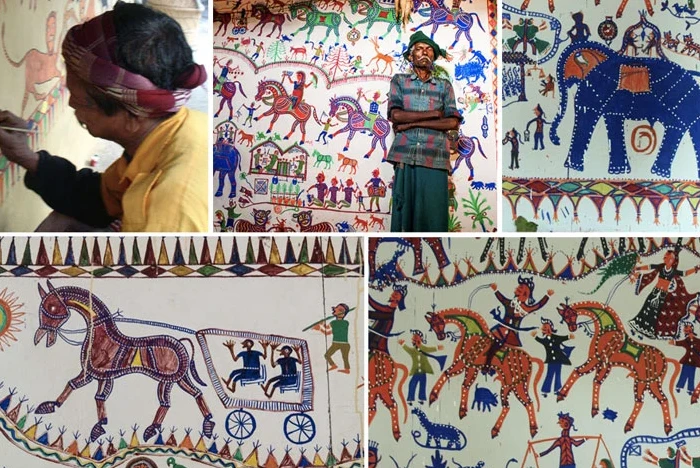
Gujarati folk art includes a wide range of traditional paintings and visual forms associated with rural and tribal communities. Pithora painting, particularly associated with tribal communities of eastern Gujarat including the Chhota Udepur region, is an important example.
Pithora traditionally has a ritual and ceremonial role, with colourful painted compositions featuring horses, deities, animals and symbolic elements.
Mata Ni Pachedi
Mata Ni Pachedi represents another important Gujarati folk-art tradition. Its combination of religious storytelling, natural colours, block printing and hand painting creates a distinctive visual language.
Lippan Kaam and Decorative Arts
Kutch is also known for decorative traditions such as Lippan Kaam, in which mud and mirror work are used to decorate walls and interiors. The reflective mirrors and clay-based patterns are particularly associated with traditional Kutchi architecture and rural homes.
Together, these traditions demonstrate the extraordinary variety of Gujarati folk art, ranging from ritual paintings to architectural decoration and textile arts.
Gujarat Handicrafts
Textiles and Embroidery
Gujarat's handicraft heritage includes an impressive range of textile traditions. Patola, Bandhani, Ajrakh, Kutch embroidery, Bhujodi weaving, Tangaliya and other textile crafts represent different regions and communities.
The state's tourism resources identify embroidery, beadwork, wood crafts, printed and woven textiles, pottery and tribal art among Gujarat's major handicraft traditions.
Wood and Lacquer Crafts
Gujarat is also known for wood-based crafts and decorative furniture. Sankheda in central Gujarat is associated with traditional lacquered wood furniture featuring colourful decorative finishes.
Wood carving and architectural craftsmanship can also be found in different parts of the state.
Metal and Bell Crafts
Kutch has a strong tradition of metal craftsmanship, including the distinctive copper bell-making tradition. Artisans shape and tune bells using traditional techniques, creating functional objects that have also become popular as decorative handicrafts.
Pottery and Mud Work
Traditional pottery and mud work are another important part of Gujarat's craft heritage. Kutch's rural architecture is particularly famous for decorated mud structures, while pottery traditions continue in several villages and communities.
Beadwork and Jewellery
Beadwork, silver ornaments and traditional jewellery add another dimension to Gujarat's craft culture. Colourful beads and metal ornaments are frequently associated with traditional clothing and community identity.
The diversity of these crafts means that Gujarat handicrafts represent far more than souvenirs. They reflect regional materials, community traditions, occupations, beliefs and artistic practices.
Traditional Villages of Gujarat
Kutch Craft Villages
Kutch is one of the best regions in Gujarat for experiencing living craft traditions. Villages such as Bhujodi, Nirona, Ajrakhpur, Hodka, Bhirandiyara, Sumrasar and Dhordo provide different perspectives on the region's textile and artisan heritage.
The Government of India's Incredible India tourism resource highlights craft-focused experiences around Bhuj, including Rogan Art in Nirona, Ajrakh printing in Ajrakhpur, embroidery in Sumrasar, traditional Bhungas in Bhirandiyara and handicrafts in Gandhi Nu Gam and Hodka.
Bhujodi
Bhujodi is particularly associated with weaving and textile crafts. It provides an opportunity to understand how handloom traditions remain part of everyday community life.
Nirona
Nirona is known for Rogan painting, copper bells and lacquer work. It is one of the most distinctive craft villages in Kutch and an important stop for travellers interested in traditional art.
Ajrakhpur
Ajrakhpur is closely associated with the traditional Ajrakh block-printing community. The village represents the continuing evolution of an old textile printing tradition using carefully prepared fabrics, blocks and dyes.
Hodka and Bhirandiyara
Hodka and Bhirandiyara provide opportunities to experience the traditional lifestyle and handicrafts of Kutch communities. Their mud architecture, embroidery, textiles and locally made products contribute to the cultural landscape of the Rann region.
Tera
Tera is a historic village in the Abdasa region of Kutch with a history extending over several centuries. Gujarat Tourism notes that Bandhani is an important livelihood for many families in the village.
Traditional villages such as these show that Gujarat culture is a living heritage, maintained not only in museums but also in homes, workshops and local communities.
Craft Tourism in Gujarat
Experiencing Crafts at the Source
One of the most meaningful ways to explore Gujarat's art and handicrafts is to visit artisan communities and see how traditional products are created.
A craft-focused Gujarat tour can introduce visitors to weavers, embroiderers, block printers, painters, potters and metal craftsmen. Such experiences provide greater insight into the time, skill and cultural knowledge involved in handmade products.
Craft Museums and Cultural Centres
Gujarat also has institutions dedicated to preserving and presenting traditional crafts. The Living and Learning Design Centre Crafts Museum near Bhuj showcases numerous Kutch embroidery styles and provides visitors with an opportunity to learn about the region's craft traditions.
Craft organisations and artisan centres also contribute to preserving traditional skills while helping craftspeople connect with contemporary markets.
Responsible Handicraft Tourism
Buying directly from artisans, cooperatives or reputable craft organisations can help support traditional craft communities. Visitors should also take time to understand the process and cultural significance of the products they purchase.
Choosing genuinely handmade products rather than mass-produced imitations can contribute to the continued visibility and sustainability of traditional crafts.
Gujarat Culture and Handicrafts for Travellers
Gujarat's culture cannot be understood through monuments alone. Its textiles, paintings, embroidery, weaving, pottery, jewellery and village traditions provide another window into the history and identity of the state.
From the precision of Patan Patola to the colourful dots of Bandhani, from the geometric patterns of Ajrakh to the mirror work of Kutch embroidery, every craft tells a different story.
The rare Rogan Art of Nirona, sacred Mata Ni Pachedi, handloom traditions of Bhujodi and diverse folk-art traditions further demonstrate the depth of Gujarat's cultural heritage.
For travellers planning Gujarat Tour Packages, adding craft villages and cultural experiences can create a richer connection with the state and its communities. Gujarat's traditional arts are not simply objects of the past—they continue to evolve through the hands of contemporary artisans.
Why Explore Gujarat's Art and Handicrafts?
Gujarat offers an exceptional cultural journey because different regions specialise in different artistic traditions. Patan represents the sophistication of Patola weaving, Jamnagar and Kutch showcase Bandhani, Ajrakhpur preserves block printing, Nirona keeps Rogan Art alive, Bhujodi celebrates weaving, and villages across Kutch preserve embroidery and folk traditions.
The result is a diverse Gujarat culture and handicrafts experience where travellers can discover textiles, paintings, embroidery, architecture, village life and traditional craftsmanship within one state.
Exploring these traditions also helps visitors understand the communities behind the crafts and the generations of knowledge that have shaped Gujarat's artistic identity.
Gujarat Tours can help travellers explore Gujarat's cultural attractions, heritage destinations, craft villages and traditional handicraft centres as part of a customised Gujarat travel experience.